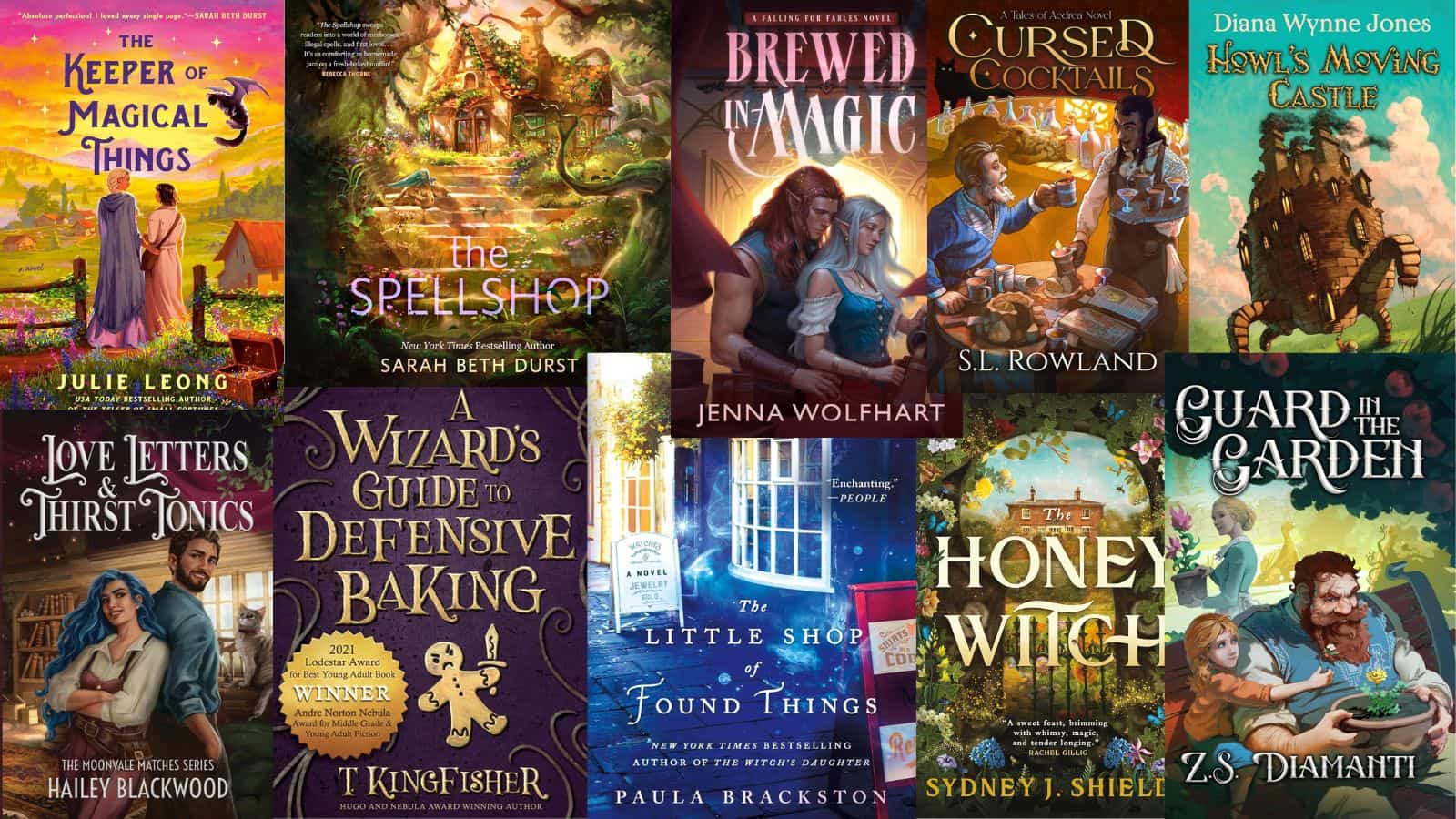
So you've been hearing the words "cozy fantasy" a lot lately. Maybe a friend mentioned it, maybe the algorithm has been relentless, or maybe you picked up one of those books with a warm illustrated cover and a title that involves tea, and now you're wondering what you've walked into.
Excellent news. You've walked into something lovely.
Cozy fantasy isn't really a set of rules. It's a feeling. The feeling of slowing down long enough to notice something beautiful. A friendship that deepens over a shared meal. A found family that sneaks up on you before you've had a chance to resist it. Characters who stop to make tea, or tend a garden, or sit by a fire, not because the plot requires it, but because those thoughtful moments are the point.
At its heart, the genre is about warmth. True connection. The belief that belonging somewhere, being seen, building something with people you love, are worth the whole story.
But here's the thing about cozy fantasy that surprises a lot of new readers: there is genuinely something for everyone. Under that warm, wide umbrella you'll find witchy small-town mysteries and slow-burn fae romance. Bookshop adventures and cottagecore magic. Stories with spice and stories that are sweet and clean. Vampires and dragons and sentient tea houses. Regency England with ghosts. A talking cat who is also a private investigator. Whatever you're in the mood for, there's almost certainly a cozy fantasy for it.
If you're new to the genre, the hardest part can be knowing where to begin. So here's a short list of some great entry points.
Start here if you want to feel like you've come home
The Very Secret Society of Irregular Witches by Sangu Mandanna
This is the book that started it all for me, and I still recommend it first to almost everyone.
Mika Moon is one of the few witches in Britain, and she keeps herself isolated by necessity. Witches who gather too close can draw dangerous attention. Her one indulgence is posting videos online, pretending to be a witch. (It's fine. No one actually believes her.)
Then a letter arrives, asking her to come and teach three young witches at a remote estate called Nowhere House.
What she finds there is a found family she didn't know she was looking for, a grumpy librarian who doesn't trust her, and the slowly dawning possibility that maybe she doesn't have to be alone.
Mandanna's prose is warm and alive, and the book has a wonderful ensemble quality. Nowhere House is full of people, and spending time there feels genuinely like coming home. The romance is slow-burn in the best way, and the central theme that belonging is something you can choose, and be chosen for, lands every time. If you finish this book and immediately want more, that's the genre working exactly as it should.
Start here if you're a fantasy reader who wants to ease in
Emily Wilde's Encyclopaedia of Faeries by Heather Fawcett
If you're coming from epic fantasy and cozy feels like unfamiliar territory, Emily Wilde is your bridge.
Emily is a Cambridge professor and the world's foremost expert on faerie lore. She is meticulous, brilliant, and absolutely terrible with people. She arrives in a remote village in the far north to research the most elusive faeries ever documented, and she has no interest in making friends, charming the locals, or tolerating her insufferably handsome academic rival Wendell Bambleby, who has followed her there and keeps making everything more complicated.
What makes this such a good entry point for fantasy readers is that Fawcett does the worldbuilding work. The faerie folklore is intricate and specific, the field-note structure gives the book a real sense of academic texture, and the mystery at the heart of it has genuine weight. But underneath all of that is warmth. The slow thaw of Emily herself, the community that forms around her despite her best efforts, and a romance that earns every page of its slow burn.
If you finish and find yourself wanting something with even more folklore depth and atmosphere, The Bear and the Nightingale by Katherine Arden and A River Enchanted by Rebecca Ross are both further along the spectrum toward literary fantasy, but worth knowing about.
Start here if you want something a little different
A Psalm for the Wild-Built (and A Prayer for the Crown-Shy) by Becky Chambers
These two slim novellas are sold independently as well as together as a set, and honestly, a set is the right way to read them.
Sibling Dex is a tea monk in a post-scarcity world where humanity has made peace with the planet and robots have long since wandered off to find themselves. While cycling through the wilderness one day, Dex encounters Mosscap, a robot who has returned from wherever the robots went, simply because they want to understand what humans need.
That question. What do people need? is the whole heart of the series. It's philosophical and deeply comforting in a way that's hard to describe without it sounding like nothing happens. Things do happen. They're just human and real.
If you're someone who wants something a little more meditative, start here.
Start here if you want whimsy and a little everyday magic
The Spellshop by Sarah Beth Durst
Kiela is a librarian at a great magical library, and she's the kind of person who gets along better with books than people. When revolution breaks out and the library burns, she flees to her childhood home, located on a remote island, with as many spellbooks as she can carry, and a plan to hide until things calm down.
Things do not calm down. Instead, she accidentally opens an illegal spellshop, acquires a very nosy neighbor, and starts turning her garden into something miraculous.
The Spellshop has a cozy, golden quality to it. The slow rhythm of island life, the pleasure of making something with your hands (or your magic), the way community sneaks up on you even when you're trying to avoid it. It's perfect if you want something that feels light and delightful without being lightweight.
A few more worth knowing about
If you read through the four above and find yourself hungry for more, here's where to head next:
Legends & Lattes by Travis Baldree — The book most people mention first when the genre comes up. An orc barbarian retires from adventuring and opens a coffee shop. The community that builds around it is genuinely lovely, and it's a great standalone if you want something light and low commitment.
Can't Spell Treason Without Tea by Rebecca Thorne — Two women walk away from their important, dangerous lives to open a bookshop that serves tea. A murderous queen is very unhappy about this.
The Teller of Small Fortunes by Julie Leong — A traveling fortune teller who only does small forecasts (will it hail? will the cow calve?) gets pulled into a found-family quest. Genuinely charming and bighearted.
The House in the Cerulean Sea by TJ Klune — A quiet, rule-following case worker is sent to assess a remote orphanage housing six supposedly dangerous magical children. One of the most tender books in the genre, and a beautiful read if belonging is the theme you're most drawn to.
One last thing
Cozy fantasy exists to make you feel safe and comforted. It emphasizes the idea that love matters, that small things matter, that warmth is worth tending.
The genre welcomes you wherever you are. You can be someone who reads nothing but epic fantasy and decide to try something quieter. You can be a total newcomer to fantasy who just wants a story that doesn't terrify you.
All are welcome. Pick any book on this list and find your cozy.
All of the books on this list are available in our Archive. Browse them here.